Vision Therapy Tools
- Aperture Rule Requires an Aperture Rule Trainer!
- Image generator for an aperture rule trainer.
- Arrow Chart
- A chart of arrows for directional exercises.
- Arrow Color Chart
- A chart of colored arrows for decoding exercises.
- Barrel Card
- ?
- Closed/Open/Flat
- ?
- Fusion Card
- ?
- Hart Chart
- ?
- Letter Saccades
- ?
- Letter Search
- ?
- Letter Tracking
- ?
- Line Counting
- ?
- Number Dots
- ?
- Number Grid
- ?
- Number Saccades
- ?
- Number Search
- ?
- Shape Chart
- ?
- Shape Color Chart
- ?
- Single Target
- ?
- Slap Tap
- ?
- Space Fixator
- ?
- Spot the Match
- ?
- Stereo Circles
- ?
- Tranaglyph
- ?
Equipment
- Aperture Rule Trainer
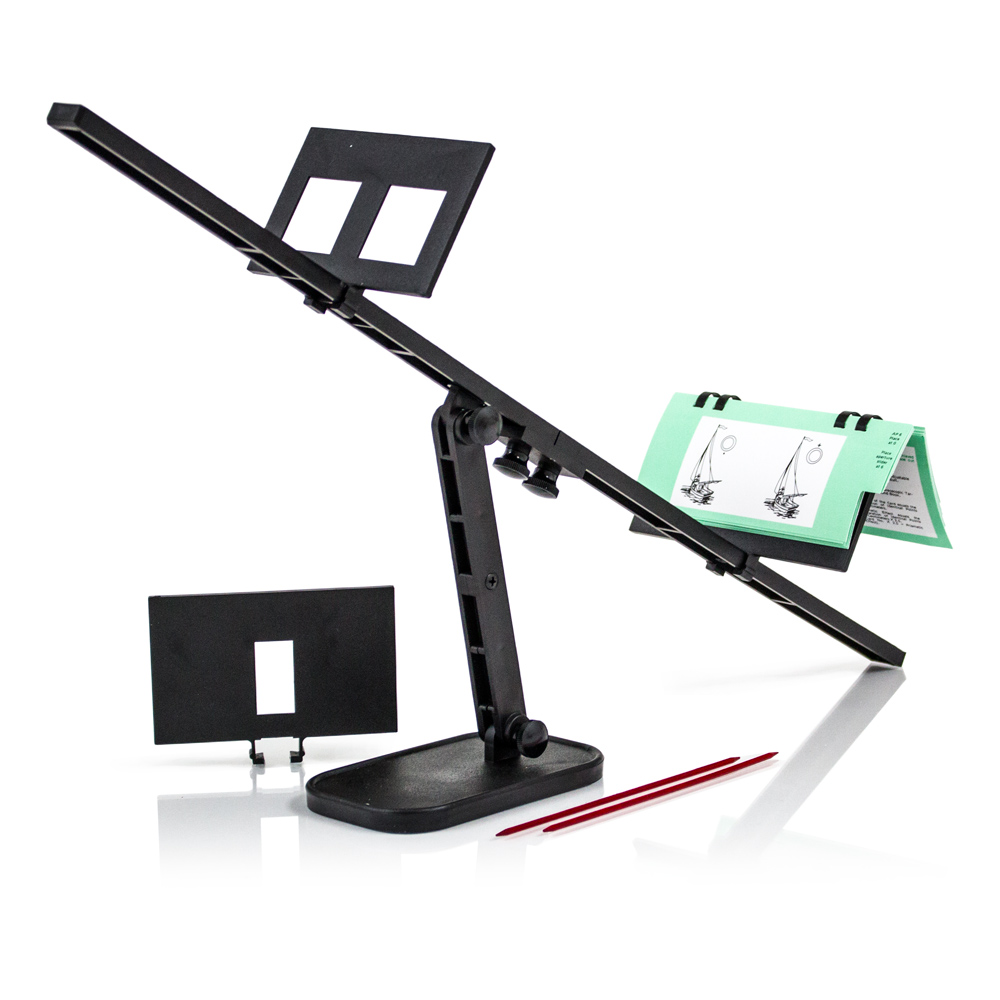
- An aperture rule trainer forces your eyes to see separate images using mechanical means.
- If a single aperture is used, your eyes are required to converge near the two images, creating a convergence demand in order to fuse the two images.
- If a double aperture is used, your eyes are required to converge distant the two images, creating a divergence demand in order to fuse the two images.
- Brock String
- A string of beads.
- Position the first bead so it is 12 inches from the handle.
- Position the second bead so it is 5 feet from the handle.
- Position the third bead so it is 8 feet from the handle.
-
Use an Alpine Butterfly Loop Knot to create a back-stop for each bead threaded onto the string.
- Prism Lens
- A triangular shaped lens that shifts the image from one eye inwards or outwards.
-
- Base-In Requires divergence.
- The thick end of the lens (the base) should face towards your nose.
- The image is shifted outwards—towards the small end of the lens (the apex).
-
- This requires your eyes to diverge and shift outwards as well to match and fuse the images.
- Base-Out Requires convergence.
- The thick end of the lens (the base) should face away from your nose.
- The image is shifted inwards—towards the small end of the lens (the apex).
-
- This requires your eyes to converge and shift inwards as well to match and fuse the images.
About
Visual Skills
- Eye Movement Control Oculomotility
- The ability to move both eyes together to point at an intended target or follow along a path.
- Includes saccades, pursuits, and vestibulo-ocular movements.
- Eye Teaming Binocularity
- The ability for each eye to send information to the brain and for the brain to combine it into one clear image.
- Poor eye teaming can result in blurred vision, moving print, reduced depth perception, and double vision.
- The brain may suppress information from one eye as an adaptation to reduce confusion.
- Convergence
- The inward movement of the eyes to focus on an object at a close distance.
- Divergence
- The outward movement of the eyes while looking at distant objects.
- Vergence
- The ability to move both eyes together to focus on a specific point.
- Includes both convergence and divergence.
- Focus Accommodation
- The ability to efficiently and quickly adjust focus between near and far distances.
- Depth Perception
- The ability to judge whether objects are closer or farther away relative to other objects.
- Peripheral Vision
- The ability to see objects to either side while looking straight ahead without moving your head.
- Gross-Motor Coordination
- The ability to integrate visual information in order to move through space accurately and comfortably.
- Fine-Motor Coordination
- The ability to integrate visual information in order to perform small, close-up activities with accuracy and comfort.
- Visual Motor Integration
- The ability to coordinate body movements with visual information.
- Combines gross-motor and fine-motor coordination.
- Laterality and Directionality
- Awareness that the body has two distinct sides (right and left).
- Visual Spatial Relations
- The ability to understand directional concepts that organize external visual space.
- Visual Spatial Orientation
- The ability to understand how the orientation of visual items affects spatial perception.
- Visual Spatial Skills
- A broad set of abilities that enable understanding where we and objects are in space.
- Supports organizing and navigating through the environment.
- Includes laterality and directionality, visual spatial relations, and visual spatial orientation.
- Eye Movement Skills
- A broad category encompassing eye movement control, eye teaming, convergence, divergence, focus accommodation, depth perception, peripheral vision, gross-motor coordination, fine-motor coordination, laterality and directionality, visual spatial relations, and visual spatial orientation.
- Visual Spatial Memory
- The ability to recognize specific features of objects or forms, remember their locations in space, and understand their relationships to one another.
- Visual Sequential Memory
- The ability to remember symbols or characters in the order they were seen.
- Visual Memory
- The ability to readily recall characteristics of visually presented information.
- Includes both visual sequential memory and visual spatial memory.
- Visualization
- The ability to create a mental picture or image.
- Figure Ground
- The ability to distinguish an object from its background.
- Visual Closure
- The ability to recognize a complete image even when only part of it is visible.
- Visual Form Recognition Visual Form Discrimination
- The ability to identify similarities and differences between objects or images.
- Visual Form Constancy
- The ability to recognize or sort objects, shapes, symbols, letters, or words despite changes in size, orientation, or position.
- Visual Acuity
- The measurement of how clearly we see at specific distances.