Trigonometric Identities
Trig Identity Cheat Sheet
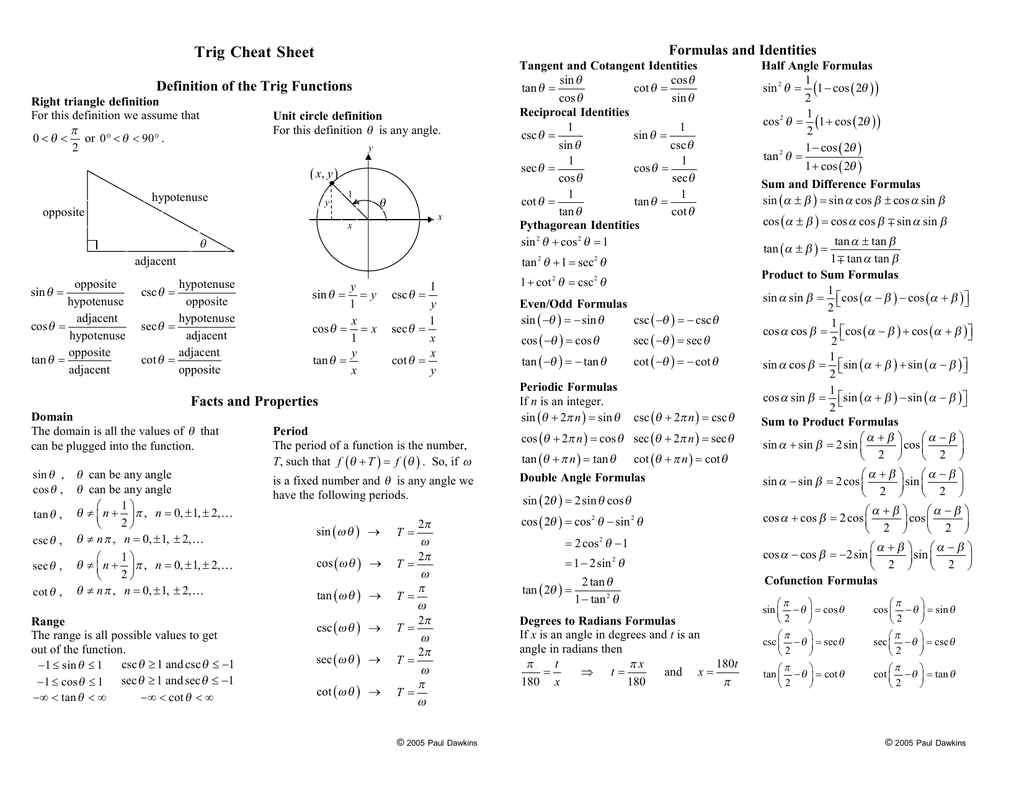
Main Trigonometric Identities
-
sin²(x) + cos²(x) = 1
-
sin(x+y) = sin(x)cos(y) + sin(y)cos(x)
-
cos(x+y) = cos(x)cos(y) - sin(x)sin(y)
Tips 2
- If top and bottom are zero, factor and cancel.
- If degrees match, divide the leading coefficients.
- Smaller degree on top -> Add in an 0x => 0
- Trig limits, split up or multiply by common 1/1 to get sinx/x.
- For finding where a function is continuous, find where x makes parts undefined.
- Finding derivative, multiply by the conjugate, cancel h's so bottom is not zero.
- Product rule: (first)'(second) + (first)(second)'
- Quotient rule: (top)'(bottom) - (top)(bottom)' / (bottom)²
- Finding tangent line: y2 - y1 = f'(x)(x2 - x1)
- Don't forget the chain rule!
- Implicit differentiation, take derivative of both sides. Solve for y'.
- Taking derivative with respect to time gives you a function where you can plug in rates.
- Mean value theorem - f'(x) = (f(b) - f(a)) / (b - a)
- Linear approximation - Solve for y in tangent-line equation. y becomes L(x).
- Write dy in terms of x if y=... Set dy = f'(x) * dx.
Tips
- sin²x + cos²x = 1
- sin²x = (1-cos2x)/2
- For square roots, multiply by the conjugate
- For functions with a sign between them over a common denominator, multiply by the conjugate.
- Cross multiply
- Take the reciprocal and flip the inequality.
- Multiply/divide by a negative # and flip the inequality.
- Set the two functions equal to each other.
- Find where x != 0 in both numerator and denominator.
- Find the roots / zeroes of the function.
- Interval = range of x values (continuous).
- Plug in the derivative value.
- Plug in h = 0 when h is no longer a problem.
Discontinuities
- Removable
- Infinite
- Jump
Finding Limits
- Plug the limit value in.
- Factor and cancel
- Split limits apart and multiply to get sinx/x = 1 = x/sinx = (1-cosx)/x
Finding Limits at Infinity
- Factor our the highest power of x.
Proofs
- Needs |f(x) - limit value| < ε to |x - approaching| <> δ
- For infinite limit, needs |f(x)| > M to |x - approaching| <> M
- For limit at infinity, needs |f(x) - limit value| < ε to |x| <> δ