Hydroponic Lettuce is Growing!Hopefully!
What is Hydroponics?
Hydroponics is a soil-less growing technique where crops, usually vegetables, are grown suspended over nutrient-rich water. Plants absorb the majority of the nutrients they need from the nutrient-rich water, with the rest being made from the sun via photosynthesis. Because the plants are not grown in soil, they are generally protected from soil-bourne pests and diseases and can be grown without environmentally-harmful pesticides.12 In a 2024 suburban sample from China, only 30% of hydroponic crops carried pesticide residue, compared with 84% of crops grown using conventional methods.3
The Kratky Method
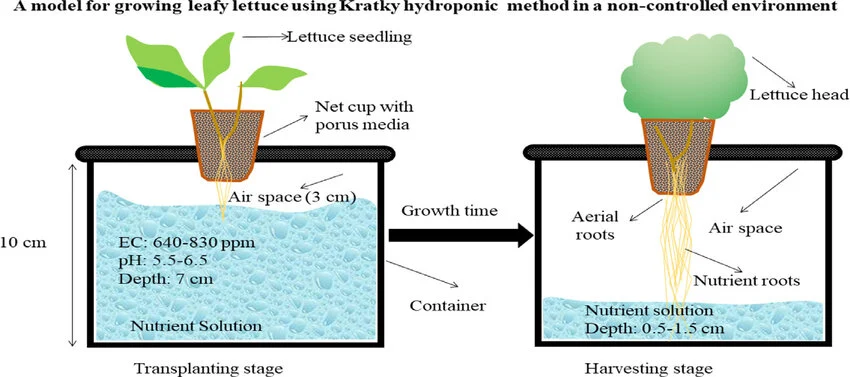
There are several well-established methods to grow hydroponic crops. Most systems sit plants in a series of pipes and use pumps to circulate water through to the roots. However, those systems are less suitable at Webster due of their large size, high cost, and maintenance burden. Our method of choice, the Kratky method, doesn't have these limitations, and was chosen for its simplicity and affordability. Named after Dr. Bernard Kratky, this hydroponic technique involves passively growing crops in a container setup with everything the plant will need throughout its lifecycle.45 No electricity or pumps are required!
In the Kratky method, plants are seeded or transplanted into a net-cup above a container of nutrient-rich water. The seeds or seedlings are supported by a porous medium, usually clay pebbles or rock wool, though many options exist. Enough water wicks up the porous medium to provide a moist environment for germination and development before the plants' roots fully extend down into the water. As the plants develop and absorb the nutrient-rich water, air flows through the porous medium to fill in the gap left by the water. Because the water does not circulate and is quickly deprived of oxygen, the plants utilize this air-gap to acquire additional oxygen to sustain cellular respiration in their roots. With a large enough container, there exists enough nutrient-rich water to sustain a plant until maturity without having to maintain or refill the container. In fact, watering a plant halfway through could cause it to drown!6
Our System
Food-safety is a valid concern for any home-grown hydroponics setup. Here, we suspend plants in a food-safe, BPA-free, polypropylene plastic net cup inside of a glass mason jar. Seedlings are started in peat moss, rock wool, or 100% pure cotton balls, and held in place by clay pebbles. The brown paper bag is being used to block out light to limit algae growth, and to maintain a cool water temperature. To manage bacterial growth, a diluted solution of 3% hydrogen peroxide may be used to clean plant roots and the medium. No pesticides will be used in the cultivation of our plants.
Future Plans
The Kratky method was selected for its low-cost, low-tech materials, and low-footprint. This summer, we plan to see how viable growing hydroponic lettuce is on campus using this method. In the future, there is potential to expand and distribute hydroponic growing kits around campus. If you are interested in growing your own leafy greens or herbs, send an email to grahamscanlon@webster.edu. If you have any questions, comments, or concerns, please contact grahamscanlon@webster.edu or Dr. Miller-Struttmann.
If you are interested in helping out with the Webster community garden, please reach out to the Webster Environmentalist Coalition at websterenvironmentalists@gmail.com.
-
Hopwood J, Code A, Vaughan M, Biddinger D, Shepherd M, Black SH, et al. How neonicotinoids can kill bees [Internet]. The Xerces Society for Invertebrate Conservation; [cited 2026 Apr 19]. Available from: https://xerces.org/publications/scientific-reports/how-neonicotinoids-can-kill-bees ↩
-
Hopwood J, Vaughan M, Black SH, Lee-Mäder E. Beyond the birds and the bees [Internet]. The Xerces Society for Invertebrate Conservation; [cited 2026 Apr 19]. Available from: https://xerces.org/publications/guidelines/beyond-birds-and-bees ↩
-
Chen S, Yao C, Zhou J, Ma H, Jin J, Song W, et al. Occurrence and risk assessment of pesticides, phthalates, and heavy metal residues in vegetables from hydroponic and conventional cultivation. Foods. 2024;13(8):1151. doi: 10.3390/foods13081151 ↩
-
Kratky BA. A suspended pot, non-circulating hydroponic method. In: Proceedings of the South Pacific Soilless Culture Conference. Acta Horticulturae. 2004;(648):83–89. doi: 10.13140/2.1.3089.1204 ↩
-
Kratky BA. Three non-circulating hydroponic methods for growing lettuce. Acta Horticulturae. 2009;843:65–72. doi: 10.17660/ActaHortic.2009.843.6 ↩
-
Imai H. AVRDC non-circulating hydroponic system. In: Tu CC, Sheen TF, editors. Proceedings of a symposium on horticultural production under structure. Taichung (Taiwan): Taiwan Agricultural Research Institute; 1987. p. 109–122. ↩
-
Gumisiriza MS, Ndakidemi PA, Mbega ER. A simplified non-greenhouse hydroponic system for small-scale soilless urban vegetable farming. MethodsX. 2022;9:101882. doi: 10.1016/j.mex.2022.101882 ↩