Occurrence and Risk Assessment of Pesticides, Phthalates, and Heavy Metal Residues in Vegetables from Hydroponic and Conventional Cultivation
A simplified non-greenhouse hydroponic system for small-scale soilless urban vegetable farming
Kratky B.A. Growing direct-seeded watercress by two non-circulating hydroponic methods. Vegetable crops. 2015 VC-7.

Hydroponic Lettuce is Growing!

Community food projects are about ensuring that communities have the right to healthy food that is grown locally and sustainably. Community food projects are important because they help make healthy food more accessible, reduce food waste, often adhere to sustainable and environmentally friendly practices, and provide free or affordable food to people. On campus, the Webster Environmental Coalition grows food with the goal of building food security on campus via a community garden behind the Pearson house. Our goal is to expand on the community food garden to ensure everyone has access to healthy food that is grown in sustainable ways. Here, we're expanding on that by experimenting with a passive method of hydroponics to further develop a network of food safety and production on campus.

What is Hydroponics?

Hydroponics is a soil-less growing technique. Unlike conventional growing, hydroponics is often regarded as a more sustainable and environmentally friendly method of growing crops. Because crops are grown indoors, risk of infections and disease are greatly reduced. Pesticide use in commercial hydroponics projects is often 3-fold less than conventional growing.

The Kratky Method

Our method of hydroponics, known as the Kratky method, is one of the easiest and low-cost ways of growing hydroponic crops in a passive, sustainable way. Named after Dr. Bernard Kratky, this hydroponic technique involves growing a crop through its entire lifecycle without the need for pumps or maintenance. Enough nutrients are water are provided to the plant seedling at transplant that allows it to grow undisturbed until harvest.

The Kratky method . Inside each bag is an incredibly simple setup that provides all the nutrients a plant needs from seed to harvest. The plants sit in a net cup above a container of nutrient-rich water adequate for the entire lifecycle of the plant, this ensures that the plant has everything is needs to grow and can be grown without intervention. As the plant grows and consumes water, air fills in the gap left over that the plant is able to use as well.

Hydroponics highlights just how marvelous photosynthesis actually is. All of the nutrients the plant consumes is make from the nutrients found in the water along with sunlight.
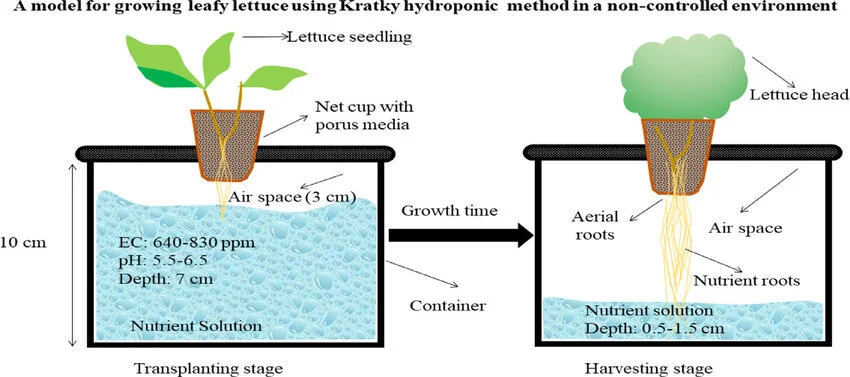
A model for growing leafy lettuce using Kratky hydroponic method in a non-controlled environment 1 2 3

  1. Chen, S., Yao, C., Zhou, J., Ma, H., Jin, J., Song, W., & Kai, Z. (2024). Occurrence and Risk Assessment of Pesticides, Phthalates, and Heavy Metal Residues in Vegetables from Hydroponic and Conventional Cultivation. Foods (Basel, Switzerland), 13(8), 1151. https://doi.org/10.3390/foods13081151

  2. Gumisiriza, Margaret & Ndakidemi, Patrick & Mbega, Ernest. (2022). A simplified non-greenhouse hydroponic system for small-scale soilless urban vegetable farming. MethodsX. 9. 101882. 10.1016/j.mex.2022.101882.

  3. Kratky B.A. Growing direct-seeded watercress by two non-circulating hydroponic methods. Vegetable crops. 2015 VC-7.