Key Takeaways
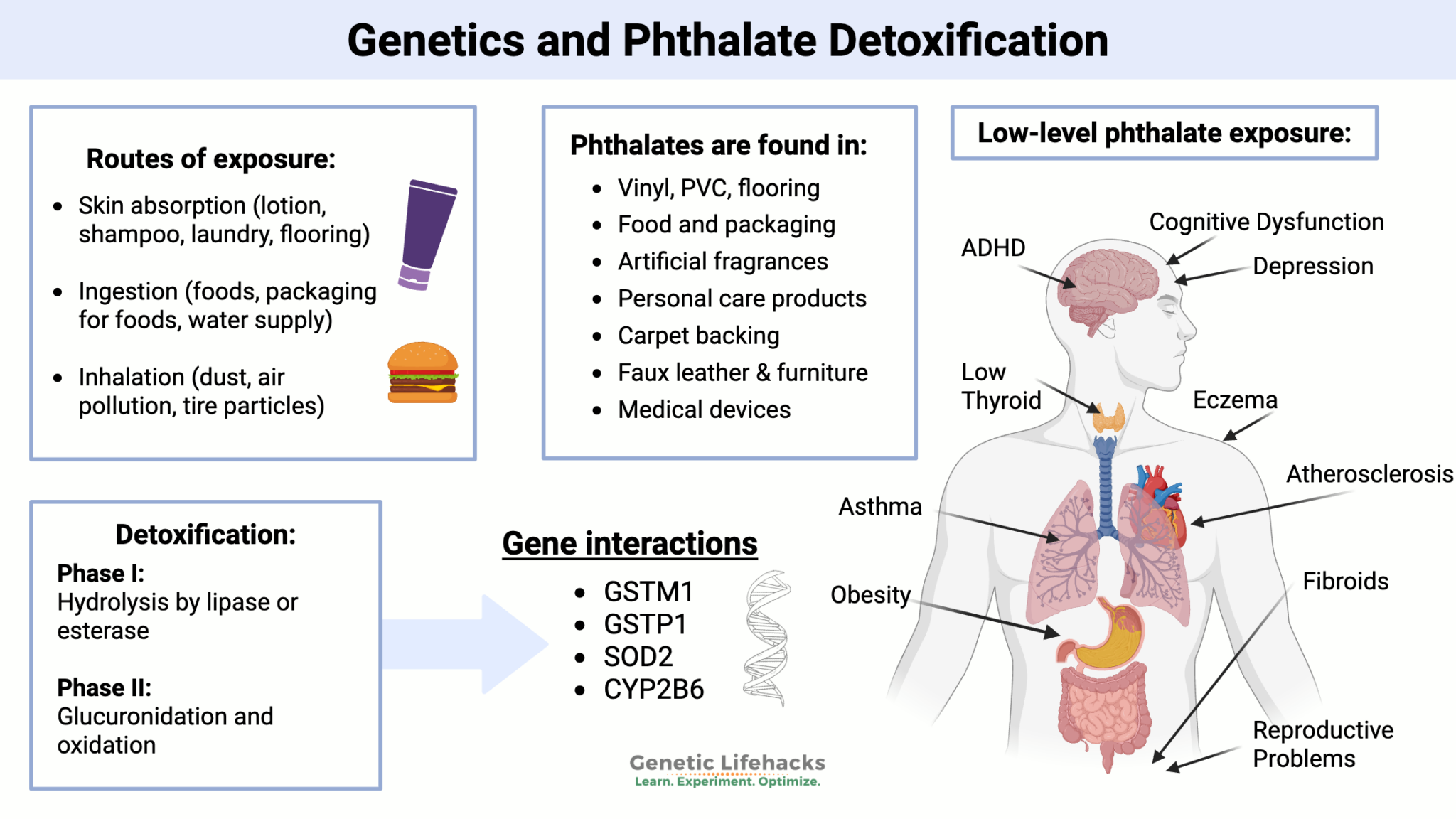
- Phthalates are a class of compounds used in plastics, fragrances, food packaging, personal care products, and more.
- They can leach into the environment and our bodies, acting as endocrine disruptors and increasing the risk of reproductive problems, obesity, asthma, ADHD, and even increased mortality from cardiovascular disease.
- Phthalates are pervasive in our food supply, from packaging to processing equipment. Studies show that almost all of us have phthalates in our bodies.
- The body metabolizes phthalates quickly, excreting them in urine, sweat, and feces. Understanding the role that your genetic variants play in phthalate detoxification can help you eliminate them more efficiently.
| Gene | RS ID | Your Genotype | Effect Allele | Effect Allele Frequency | Notes About Effect Allele |
|---|
| GSTP1 | rs1695 | AA | G | 0.32 | Reduced function; slower elimination of phthalates |
| SOD2 | rs5746136 | CC | T | 0.28 | Higher phthalate levels; increased asthma risk |
| CYP2B6 | rs3745274 | TT | T | 0.25 | TT: decreased CYP2B6 enzyme needed for eliminating phthalates |
| GSTM1 | rs366631 | AA | A | 0.78 | AA: deletion (null) GSTM1 gene; Women with phthalate exposure are at a 5-fold increased risk of fibroids. |
| HSPA1L | rs2227956 | AG | G | 0.15 | G/G: decreased HSP70; insulin resistance not tied to phthalate exposure |
| CYP2C9 | rs1799853 | CC | T | 0.1 | Decreased breakdown and clearance of phthalates |
| CYP2C8 | rs11572080 | CC | T | 0.08 | Decreased breakdown and clearance of phthalates |