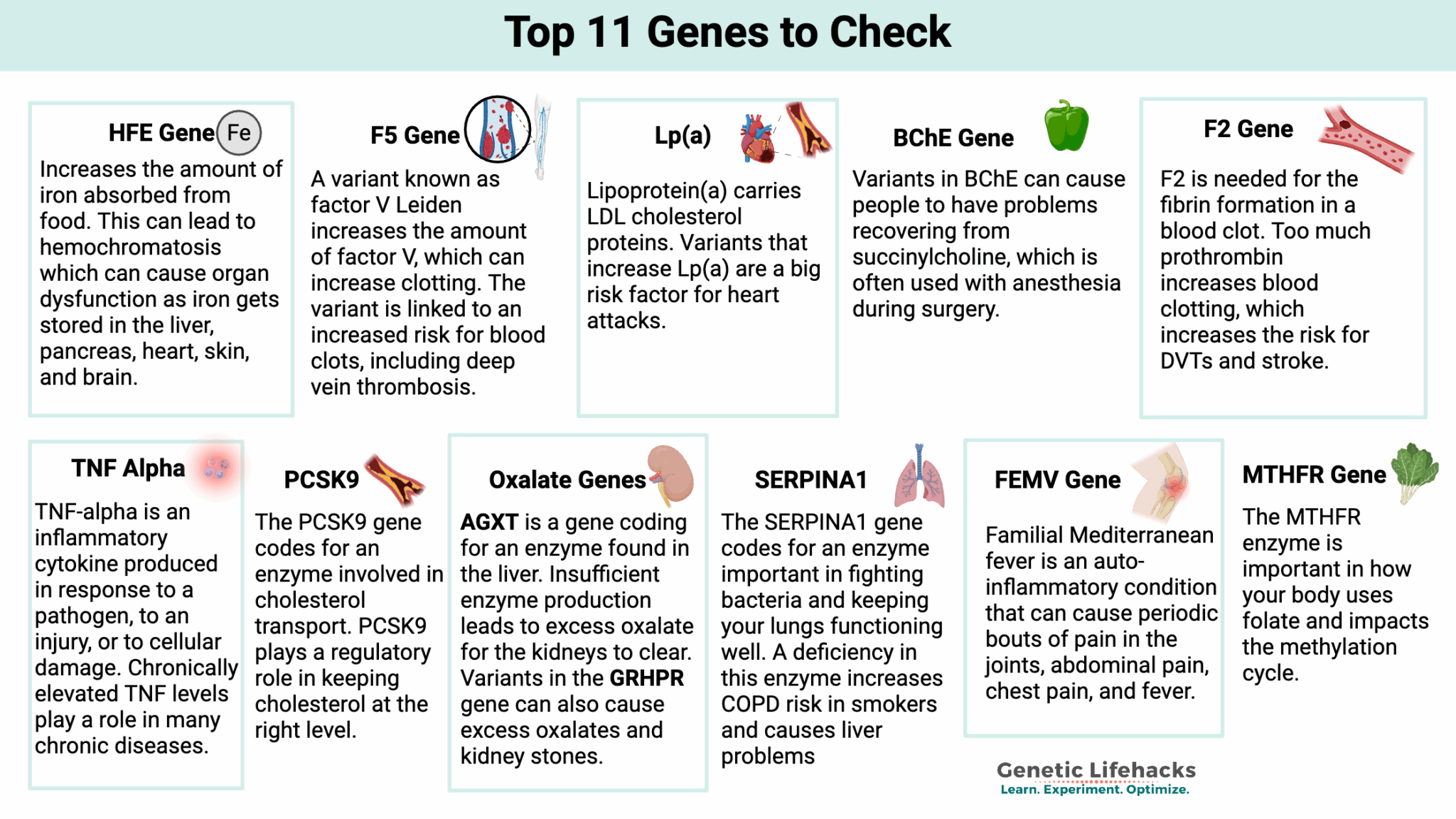
Getting started with learning about your genes can be overwhelming! Let me help you cut through the information overload. This guide offers a research-backed shortlist of genetic variants that can directly impact health and wellness.
Instead of overwhelming you with data, I’m focusing on 11 of the most clinically relevant genes that are found in 23andMe and AncestryDNA raw data. These are genes with robust research showing significant, actionable health risks or traits.
For each gene, you’ll learn:
Why it matters: A brief summary of its clinical importance
Which variants (SNPs) to look at: Members will see their genotypes right in the report, with highlighting to indicate a risk
Where to get more information: If you have a highlighted variant, you can find more details, including what to talk with your doctor about and possible natural solutions.
Top 11 List: Genes and SNPs To Check in Your Raw Data If you have a risk variant highlighted below, be sure to click through to read the full article for in-depth background science and the “Lifehacks” that may help mitigate any negative effects. Knowledge is power here, and understanding your genes can help you prevent and avoid health issues.
#1) HFE Gene (hemochromatosis risk) Why it matters: Mutations in the HFE gene increase the amount of iron absorbed from food. It causes increased iron storage in various tissues in the body. Eventually, this can lead to hemochromatosis or iron overload. Symptoms of too much iron can include joint pain (often moving from joint to joint) and fatigue. Hemochromatosis can involve organ dysfunction as iron gets stored in the liver, pancreas, heart, skin, and brain.
Check your genetic data for rs1800562 C282Y (23andMe v4, v5; AncestryDNA):
A/A: two copies (homozygous) C282Y; increased iron absorption, most common cause of hereditary hemochromatosis, check ferritin and transferrin saturation A/G: one copy of C282Y, increased iron absorption can cause hemochromatosis in some people (found in about 5% of Caucasian population) G/G: typical Members: Your genotype for rs1800562 is GG.
Check your genetic data for rs1799945 H63D (23andMe v4, v5; AncestryDNA):
G/G: two copies (homozygous) H63D; can cause mild hemochromatosis in some people; increased ferritin levels (two copies of H63D) C/G: somewhat higher ferritin levels, usually not a problem unless combined with C282Y (found in 14% of Caucasian population) C/C: typical Members: Your genotype for rs1799945 is CC.
Next step››› If you have either of these highlighted, read the full article on iron overload
#2) F5 Gene (factor V Leiden blood clot risk) Why it matters: Factor V is a clotting factor essential for forming blood clots. A gene variant known as factor V Leiden increases the amount of factor V, which can increase clotting. The variant is linked to an increased risk of blood clots, including deep vein thrombosis (DVT).
Check your genetic data for rs6025 (23andMe v4, v5; AncestryDNA):
C/C: typical C/T: one copy of factor V Leiden variant, significantly increased risk of blood clots (found in about 5% of Caucasian population) T/T: two copies of factor V Leiden, significantly increased risk of blood clots, DVT Members: Your genotype for rs6025 is CC.
Next step›››If you have the F5 variant highlighted, read the full article on factor V Leiden.
#3) Lp(a) (heart attack risk) Why it matters: Lipoprotein(a) carries LDL cholesterol proteins. Elevated Lp(a) is a big risk factor for heart attacks, and elevated Lp(a) is mainly due to genetics rather than lifestyle or diet. Understanding your Lp(a) level can help you and your doctor to focus on ways to reduce this heart attack risk factor.
Check your genetic data for rs3798220 (23andMe v4, v5,AncestryDNA):
C/C: risk of elevated Lp(a), significantly increased risk for heart disease – 3.7x risk of aortic stenosis[ref][ref] C/T: risk of elevated Lp(A), increased risk for heart disease, and increased aortic stenosis risk. T/T: typical Members: Your genotype for rs3798220 is TT.
Check your genetic data for rs10455872 (23andMe v4, v5; AncestryDNA):
G/G: likely elevated Lp(a), significantly increased risk for heart disease – 2x risk of aortic stenosis[ref][ref] A/G: likely elevated Lp(A), increased risk for heart disease A/A: typical Members: Your genotype for rs10455872 is AA.
Next step››› If you have either Lp(a) variant highlighted, read the full article on lipoprotein(a).
#4) BChE Gene (A-variant and anesthesia) Why it matters: The BChE enzyme is vital for breaking down certain toxins affecting acetylcholine, an important neurotransmitter. Mutations in BChE can cause people to have problems recovering from succinylcholine, which is often used with anesthesia during surgery.
Check your genetic data for rs1799807 (23andMe v4, v5; AncestryDNA):
T/T: typical C/T: one copy of A-variant, may have delayed recovery from succinylcholine anesthesia[ref][ref][ref][ref]. C/C: two copies of A-variant (rare), severe BChE deficiency, may have delayed recovery from succinylcholine anesthesia Members: Your genotype for rs1799807 is TT.
Next step››› If you have either BChE variant highlighted, read the full article on BChE.
#5) F2 Gene (Prothrombin, blood clot risk) Why it matters: Prothrombin (or factor 2) is part of the blood-clotting cascade of events. It is needed for the fibrin formation in a blood clot. Too much prothrombin increases blood clotting, which increases the risk of deep vein thrombosis (DVTs).
Check your genetic data for rs1799963, G20210A (23andMe i3002432; AncestryDNA):
A/A: a large increase in the risk of blood clots,[ref] A/G: increased risk of blood clots G/G: typical Members: Your genotype for i3002432 / rs1799963 is AG.
Next step››› If you have the F2 variant highlighted, read the full prothrombin article.
#6) PCSK9 (high cholesterol) Why it matters: The PCSK9 gene codes for an enzyme involved in cholesterol transport. The enzyme binds to LDL particles, which transport fat molecules, including cholesterol, throughout the body. PCSK9 plays a regulatory role in keeping cholesterol at the right level.
Check your genetic data for rs505151 (23andMe v4, v5; AncestryDNA):
G/G: increased LDL, increased risk of coronary artery disease[ref][ref][ref] A/G: somewhat increased LDL, increased risk of coronary artery disease. About 20% of the population globally carries this risk allele. A/A: typical Members: Your genotype for rs505151 is AA.
Check your genetic data for rs28942112 (23andMe i5000370, v4; AncestryDNA):
C/C: very rare, greatly increased LDL; considered pathogenic for familial hypercholesterolemia[ref] C/T: rare, greatly increased LDL[ref] T/T: typical Members: Your genotype for rs28942112 (i5000370) is TT.
Next step››› If you have either PCSK9 variant highlighted, read the full article on PCSK9.
#7) Oxalate Genes (kidney stones due to oxalates) Why it matters: AGXT (alanine-glyoxylate aminotransferase) is a gene coding for an enzyme found in the liver. It helps convert a form of oxalate made by the body (glyoxylate) into glycine. Insufficient enzyme production leads to excess oxalate for the kidneys to clear. Mutations in the GRHPR gene can also cause excess oxalate levels and kidney stones.
Check your genetic data for rs34116584 (23andMe v4 only):
T/T: significantly increases the risk of hyperoxaluria[ref][ref] C/T: increased risk of hyperoxaluria (especially if coupled with another mutation)[ref]. Over 10% of the population carries this variant. C/C: typical Members: Your genotype for rs34116584 is CC.
Check your genetic data for rs180177309 (23andMe i5012629 v4, v5):
II or AAGT/AAGT: typical DI or -/AAGT: carrier of a pathogenic allele for primary hyperoxaluria type 2 DD or -/-: primary hyperoxaluria type 2[ref] Members: Your genotype for rs180177309 is AA or 23andMe i5012629 is TT.
Check your genetic data for rs80356708 (23andMe i5012628 v4, v5):
II (or G/G): typical DI (or – / G): carrier of a pathogenic allele for primary hyperoxaluria type 2 DD (or -/-): primary hyperoxaluria type 2[ref] Members: Your genotype for rs80356708 is GG.
Next step››› If you have either oxalate variant highlighted, read the full article on oxalates.
#8) SERPINA1 Gene (Alpha-1 Antitrypsin Deficiency) Why it matters: The SERPINA1 gene codes for an enzyme important in fighting bacteria and keeping your lungs functioning well. A partial deficiency in this enzyme increases COPD risk in smokers and causes liver problems, especially in people who drink alcohol. Two copies of the mutations will cause alpha-1 antitrypsin deficiency.
Check your genetic data for rs28929474 (23andMe v4, v5; AncestryDNA):
T/T: two copies of PiZ mutation, alpha-1 antitrypsin levels often less than 30% of normal[ref] C/T: one copy of the PiZ mutation C/C: typical Members: Your genotype for rs28929474 is CC.
Check your genetic data for rs17580 (23andMe v4, v5; AncestryDNA *):
A/A: two copies of PiS mutation A/T: one copy of the PiS mutation T/T: typical Members: Your genotype for rs17580 is TT.
Next step››› If you have either SERPINA1 variant highlighted, read the full article on Alpha-1 Antitrypsin Deficiency.
#9) FEMV Gene (familial Mediterranean fever) Why it matters: Familial Mediterranean fever is an auto-inflammatory condition that can cause periodic bouts of pain in the joints, abdominal pain, chest pain, and fever. Not everyone who carries the mutations will end up with periodic episodes.
Check your genetic data for rs61732874 (23andMe i4000409 v4, v5; AncestryDNA):
A/A: Familial Mediterranean Fever mutation A744S (two copies) A/C: one copy of FMF variant C/C: typical Members: Your genotype for rs61732874 is CC.
Check your genetic data for rs3743930 (23andMe v4, v5; AncestryDNA):
G/G: Familial Mediterranean Fever mutation E148Q (two copies) C/G: one copy of FMF variant C/C: typical Members: Your genotype for rs3743930 is CC.
Check your genetic data for rs104895083 (23andMe i4000403 v4, v5):
C/C: Familial Mediterranean Fever mutation F479L (two copies) C/G: one copy of FMF variant G/G: typical Members: Your genotype for rs104895083 is GG.
Check your genetic data for rs104895094 (23andMe i4000407 v4, v5):
C/C: Familial Mediterranean Fever mutation K695R (two copies) C/T: one copy of FMF variant T/T: typical Members: Your genotype for i4000407 is —.
Check your genetic data for rs28940580 (23andMe v4, v5):
G/G: Familial Mediterranean Fever mutation M680I (two copies) C/G: one copy of FMF variant C/C: typical Members: Your genotype for rs28940580 is CC.
Check your genetic data for rs28940578 (23andMe v4, v5; AncestryDNA):
T/T: Familial Mediterranean Fever mutation M694I (two copies) C/T: one copy of FMF variant C/C: typical Members: Your genotype for rs28940578 is CC.
Check your genetic data for rs61752717 (23andMe i4000406 v4, v5):
C/C: Familial Mediterranean Fever mutation M694V (two copies) C/T: one copy of FMF variant T/T: typical Members: Your genotype for rs61752717 is TT.
Check your genetic data for rs11466023 (23andMe v4, v5):
A/A: Familial Mediterranean Fever mutation P369S (two copies) A/G: one copy of FMF variant G/G: typical Members: Your genotype for rs11466023 is GG.
Check your genetic data for rs104895097 (23andMe i4000410 v4, v5 ; AncestryDNA):
T/T: Familial Mediterranean Fever mutation R761H (two copies) C/T: one copy of FMF variant C/C: typical Members: Your genotype for rs104895097 is CC.
Check your genetic data for rs28940579 (23andMe v4, v5; AncestryDNA):
G/G: Familial Mediterranean Fever mutation V726A (two copies) A/G: one copy of FMF variant A/A: typical Members: Your genotype for rs28940579 is AA.
Next step››› If you have a MEFV mutation highlighted, read the full article on familial Mediterranean fever.
#10 MTHFR Gene (Methylation cycle): Why it matters: The MTHFR enzyme is important in how your body uses folate and impacts the methylation cycle. A low-folate diet combined with the MTHFR variants increases the risk for many chronic conditions.
Check your genetic data for rs1801133 (23andMe v4, v5; AncestryDNA):
G/G: typical A/G: one copy of MTHFR C677T allele (heterozygous), decreased by 40% A/A: two copies of MTHFR C677T (homozygous), decreased by 70 – 80% Members: Your genotype for rs1801133 is AA.
Check your genetic data for rs1801131 (23andMe v4, v5; AncestryDNA):
T/T: typical G/T: one copy of MTHFR A1298C (heterozygous), slightly decreased enzyme function G/G: two copies of MTHFR A1298C (homozygous), decreased enzyme by about 20% Members: Your genotype for rs1801131 is TT.
Next step››› If you have an MTHFR variant highlighted, read the full article on MTHFR.
#11 TNF Gene (Chronic Inflammation): Why it matters: TNF-alpha is an inflammatory cytokine produced in response to a pathogen, to an injury, or to cellular damage or cancer. It’s important to have a strong inflammatory response – – but only when needed. Excess inflammation or chronically elevated TNF levels play a causal role in many chronic diseases. Understanding your propensity towards inflammation can help you know how and when to target TNF-alpha.
This final topic ties together the top 10 genes above! Think of these two TNF variants as turning up the volume on all of the above variants. For example, an excessive TNF response exacerbates the damage of storing too much iron.
Check your genetic data for rs1800629 -308A/G (23 and Me v4, v5; AncestryDNA):
A/A: Higher TNF-alpha levels. Increased risk of: ulcerative colitis[ref] celiac disease[ref] (note – must have HLA type also), septic shock[ref], diabetic foot ulcers[ref], asthma[ref] , Hashimoto’s thyroiditis[ref], skin infections[ref], periodontitis[ref], asthma[ref] in children, COPD[ref], gum disease[ref], heart disease[ref]; nasal polyps[ref] sleep apnea[ref] Lower risk of: Malaria (half the risk)[ref], tuberculosis[ref] osteoporosis[ref], stroke[ref] A/G: somewhat higher TNF-alpha levels – see above G/G: typical Members: Your genotype for rs1800629 is GG.
Check your genetic data for rs361525 -238A/G (23andMe v4, v5; AncestryDNA):
A/A: higher TNF-alpha levels[ref], increased risk of psoriasis[ref], asthma[ref], COPD[ref], periodontitis[ref] greater severity in cystic fibrosis[ref] A/G: somewhat higher TNF-alpha levels G/G: typical Members: Your genotype for rs361525 is GG.
Next step››› If you have a TNF variant highlighted, read the full article on TNF-alpha.
What’s next? Now that you’ve checked out some of the most impactful genes on Genetic Lifehacks, take some time to dive into how combinations of genetic variants interact with environmental factors to affect YOUR health and wellness.
Here are just a few examples:
Early morning waking, if you aren’t sleeping through the night, high histamine foods could be a cause Autoimmune overview – for anyone with an autoimmune disease, understanding the genetic susceptibility is important Supplement connections explain which supplements connect to different genetic topics Please be sure to talk with your doctor or healthcare provider if you have any questions or need medical advice.
My Variants
| Gene | RS ID | Your Genotype | Effect Allele | Effect Allele Frequency | Notes About Effect Allele |
|---|---|---|---|---|---|
| HFE | rs1800562 | GG | A | 0.05 | C282Y mutation, most common cause of hereditary hemochromatosis |
| HFE | rs1799945 | CC | G | 0.13 | H63D mutation, milder buildup of iron, problem when combined with HFE |
| F5 | rs6025 | CC | T | 0.2 | factor V Leiden, significantly increased risk of blood clots |
| LPA | rs3798220 | TT | C | 0.02 | risk of elevated Lp(a), significantly increased risk for heart disease |
| LPA | rs10455872 | AA | G | 0.06 | likely elevated Lp(A), increased risk for heart disease |
| BCHE | rs1799807 | TT | C | 0.01 | A-variant, may have delayed recovery from succinylcholine |
| F2 | rs1799963 | AG | A | 0.01 | Prothrombin variant, increased risk of DVT |
| PCSK9 | rs505151 | AA | G | 0.04 | increased LDL, increased risk of coronary artery disease |
| PCSK9 | rs28942112 | TT | C | 0 | increased LDL, increased risk of coronary artery disease |
| PCSK9 | i5000370 | -- | C | 0 | increased LDL, increased risk of coronary artery disease |
| AGXT | rs34116584 | CC | T | 0.13 | Increased risk of hyperoxaluria, especially if combined with another AGXT mutation |
| AGXT | rs180177309 | AA | D | 0 | Hyperoxaluria mutation |
| AGXT | rs80356708 | GG | D | 0.0003 | Hyperoxaluria mutation |
| SERPINA1 | rs28929474 | CC | T | 0.01 | Pi*Z mutation, two copies causes alpha-1 antitrypsin deficiency |
| SERPINA1 | rs17580 | TT | A | 0.03 | Pi*S mutation, two copies causes alpha-1 antitrypsin deficiency |
| MEFV | rs61732874 | CC | A | 0.002 | familial Mediterranean fever mutation |
| MEFV | rs3743930 | CC | G | 0.03 | familial Mediterranean fever mutation |
| MEFV | rs104895083 | GG | C | 0.00009 | familial Mediterranean fever mutation |
| MEFV | i4000403 | -- | C | 0.00009 | familial Mediterranean fever mutation |
| MEFV | rs104895094 | TT | C | 0.006 | familial Mediterranean fever mutation |
| MEFV | i4000407 | -- | C | 0.006 | familial Mediterranean fever mutation |
| MEFV | rs28940580 | CC | G | 0.0001 | familial Mediterranean fever mutation |
| MEFV | rs28940578 | CC | T | 0.00004 | familial Mediterranean fever mutation |
| MEFV | i4000406 | -- | C | 0.0003 | familial Mediterranean fever mutation |
| MEFV | rs11466023 | GG | A | 0.01 | familial Mediterranean fever mutation |
| MEFV | i4000410 | -- | T | 0.00009 | familial Mediterranean fever mutation |
| MEFV | rs28940579 | AA | G | 0.002 | familial Mediterranean fever mutation |
| MTHFR | rs1801133 | AA | A | 0.33 | MTHFR C677T variant, decreased enzyme function |
| MTHFR | rs1801131 | TT | G | 0.3 | MTHFR A1298C variant, slightly decreased enzyme function |
| TNF | rs1800629 | GG | A | 0.15 | Higher TNF levels, increased risk of chronic disease and autoimmune diseases |
| TNF | rs361525 | GG | A | 0.05 | Higher TNF levels, increased risk of chronic disease and autoimmune diseases |