Key Takeaways
- Homocysteine is produced from methionine in the methionine cycle and can either be remethylated back to methionine or converted through the transsulfuration pathway into cysteine and glutathione.
- High homocysteine can cause oxidative stress, mitochondrial dysfunction, and endoplasmic reticulum stress.
- Both homocysteine and its reactive metabolite homocysteine thiolactone can damage blood vessels and other tissues, and even levels in the upper “normal” range are associated with increased all‑cause mortality
- Genetic variants can increase the risk of high homocysteine, depending on your intake of B vitamins and choline. Lifestyle factors and the gut microbiome can also play a role.
Homocysteine
In our ongoing exploration of heart health through genetics, today we will dive into the world of homocysteine – a sulfur-containing amino acid that plays a pivotal role in your cardiovascular well-being.
The Role of Homocysteine in Heart Health
While high homocysteine does not cause a large absolute risk increase for heart disease, this is one biomarker that has fairly straightforward solutions when incorporating genetics.
The Methionine Connection
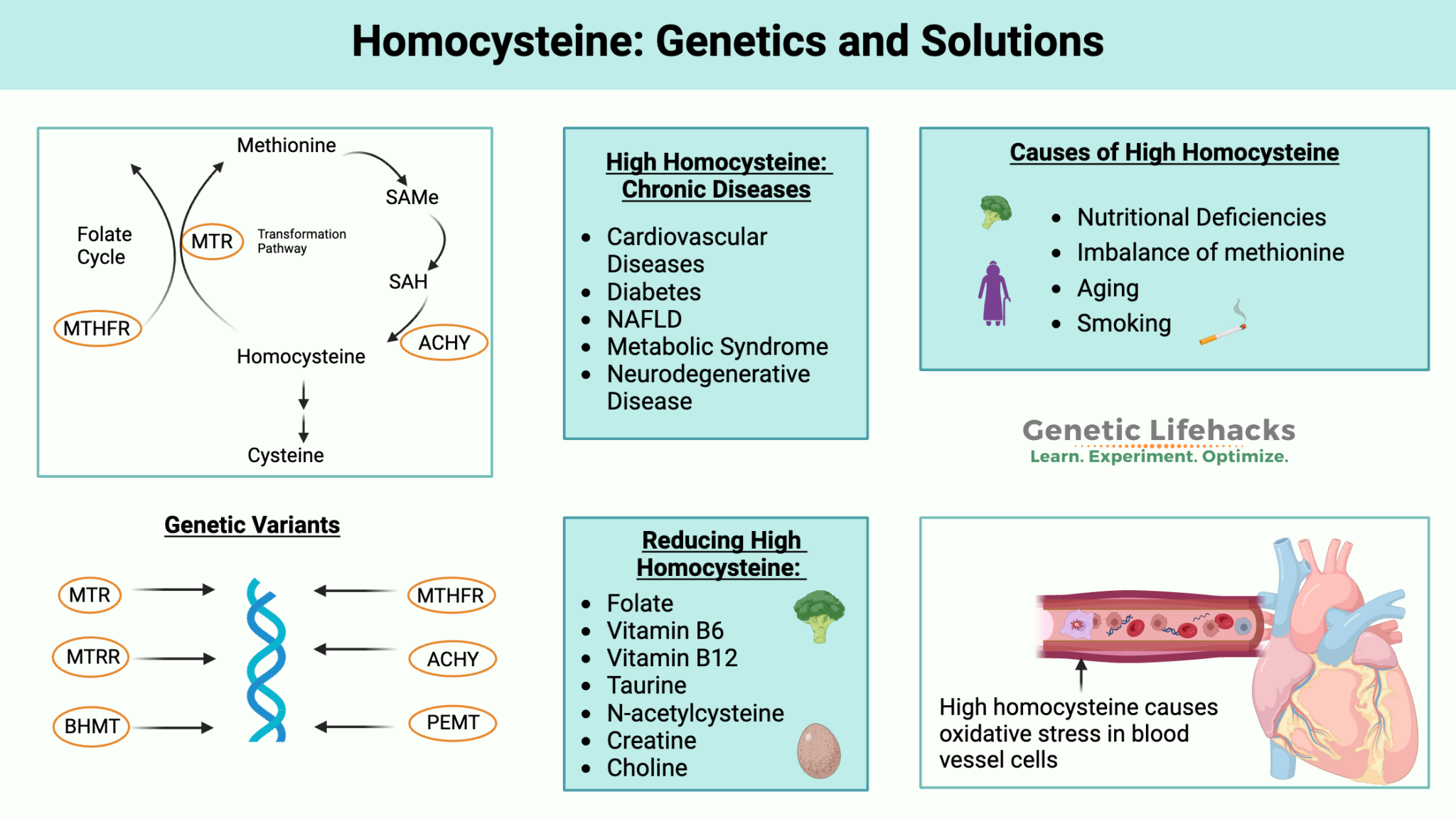
To understand homocysteine's significance, let's first explore methionine, an essential amino acid derived from protein-rich foods. Methionine serves as the cellular source of methyl groups, crucial in various cellular reactions. In the methionine cycle, methionine is converted to SAM-e (S-adenosyl-methionine), which can transfer methyl groups for critical cellular reactions. Once SAM-e loses a methyl group, it becomes SAH (S-adenosyl-homocysteine), which, in turn, hydrolyzes to form homocysteine.
Methyl Groups:
Methyl groups are vital in various cellular functions, such as converting serotonin to melatonin, producing creatine and phosphatidylcholine, synthesizing neurotransmitters, gene silencing, and detoxifying certain toxins. When these pathways face disruptions, homocysteine levels can surge, leading to adverse long-term health effects.
Balancing Act: Homocysteine Regulation
Your cells maintain relatively constant homocysteine levels through continuous cycles. These intricate mechanisms involve the conversion of homocysteine back to methionine or its transformation into other pathways.
High Homocysteine: Is it really a problem?
Epidemiological studies have linked elevated homocysteine levels to an increased risk of blood clots, heart attacks, and strokes. However, researchers have questioned whether high homocysteine causes these conditions or merely serves as a marker of underlying cellular pathway alterations.
Recent research sheds light on how and why elevated homocysteine levels can harm the cardiovascular system and overall health.
Post-Translational Protein Modifications:
Studies reveal that homocysteine can bind to proteins after their synthesis through post-translational protein modification. This process involves altering the structure and function of proteins, potentially affecting proteins relevant to cardiovascular and neurodegenerative diseases.
Oxidative Stress and ER Stress:
High homocysteine levels correlate with increased oxidative stress and endoplasmic reticulum (ER) stress. ER stress can lead to cell death if the unfolded protein response pathway is overwhelmed. High homocysteine levels can trigger ER stress and activate this pathway, potentially contributing to cell death.
Mendelian randomization studies indicate a causal relationship between high homocysteine and several chronic diseases, including cardiovascular disease.
Defining High Homocysteine
While the normal range for homocysteine levels varies slightly, hyperhomocysteinemia, or high homocysteine, is generally defined as levels exceeding 15 μmol/L. However, the optimal range remains less clear and may vary among individuals. A simple blood test can tell you your homocysteine levels.
Other
Homocysteine seems like a boring topic. It's an amino acid that is best known for being tested to check for heart disease risk. (And let's face it -- heart disease is not a hot topic.)
But homocysteine is underappreciated. Normally, it is recycled in the methylation cycle, back to methionine, or it gets converted to cysteine and glutathione. The system usually works well.
High homocysteine can be due to low folate, low B12, low B6, low glutathione, or even gut dysbiosis (the gut microbiome synthesizes B vitamins).
The trouble starts when homocysteine levels get too high. Excess homocysteine can convert to a metabolite called homocysteine-thiolactone, which triggers oxidative stress, mitochondrial dysfunction, and endoplasmic reticulum stress. At the cellular level, it can even substitute for methionine in proteins, causing them not to function correctly or even misfold.
Beyond the well-known link to endothelial dysfunction for heart disease, high homocysteine can also increase the risk of Alzheimer's, brain atrophy, depression, diabetes, and osteoporosis.
So it turns out that high homocysteine isn't just a marker for heart disease. It can be a hidden cause of multiple chronic issues. Just a nagging little issue that multiplies inflammation and mitochondrial problems...
What can you do about it? If you have genetic variants that increase the risk of high homocysteine, it may be worth testing it and then making changes to lower your levels (folate, B6, riboflavin -- and more in the full article in the Lifehacks section).
Talk to your doctor about it, or, in the US, you can order blood tests yourself in most states. A test for homocysteine is usually around $35 on UltaLabs, though prices vary. Be sure to shop around for coupon codes and sales. (Who knew that lab test prices could vary so much?)
Speaking of testing... I need your help.
I've created a new methylation cycle report that shows just your genotype, the effect, and personalized information. My goal is to make the methylation cycle genes more straightforward and easily understood.
I'd love some of you to beta test it for me. If you spot any errors, confusing sections, or formatting issues, just send me an email (or reply to this email).
Finally, I want to apologize to any of you who ended up running into problems with reaching the site this week. I would love to blame the crashes on solar storms or an internet outage, but I simply had a bunch of bots hammering beyond what my server could manage. And I had been putting off the necessary upgrades... Sigh. It's now been handled.
Which brings me full circle: Don't put off the changes needed for your health the way I put off the server upgrade. You don't want your health (or your website) crashing repeatedly over the holidays. Take care of the elevated CPU load homocysteine levels before they become a bigger problem.
Table 1: My Genetic Variants
| Gene | RS ID | Your Genotype | Effect Allele | Effect Allele Frequency | Notes About Effect Allele |
|---|---|---|---|---|---|
| MTHFR | rs1801133 | AA | A | 0.33 | MTHFR C677T, higher homocysteine levels, especially if folate is lacking |
| NOX4 | rs11018628 | C | 0.06 | decreased homocysteine, decreased stroke risk | |
| MTR | rs1805087 | AG | G | 0.19 | increased risk of cognitive impairment due to higher homocysteine |
| MTR | rs2275565 | GT | T | 0.22 | associated with higher homocysteine levels |
| MTRR | rs1801394 | GG | G | 0.5 | somewhat increased homocysteine levels, especially if riboflavin is low |
| CBS | rs5742905 | AA | G | 0.005 | risk of increased homocysteine, responsive to vitamin B6 |
| PEMT | rs7946 | TT | T | 0.68 | TT: homocysteine increases with low folate diet |
| BHMT | rs3733890 | AG | A | 0.3 | reduced conversion of choline to betaine |
If you have the MTHFR variant (first one) and high homocysteine, then folate is likely to be important in reducing homocysteine levels. You could add more folate-rich foods to your diet, or supplement with a low dose of methylfolate if you don’t get the 400 mcg of folate recommended in the RDA.
The MTR and MTRR variants are related to vitamin B12. Consider whether you should add supplemental B12, especially if you are older or eating a primarily vegetarian diet.
If you have the CBS variant highlighted, additional vitamin B6 may help to reduce homocysteine.
The BHMT and PEMT variants are related to choline. Increasing your intake of choline-rich foods may also help with reducing homocysteine.
As always, talk with your doctor or healthcare provider if you have any questions about supplements or interactions with medications.